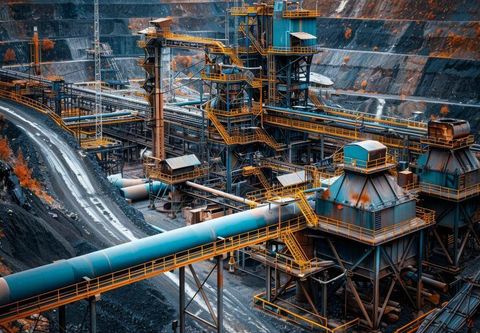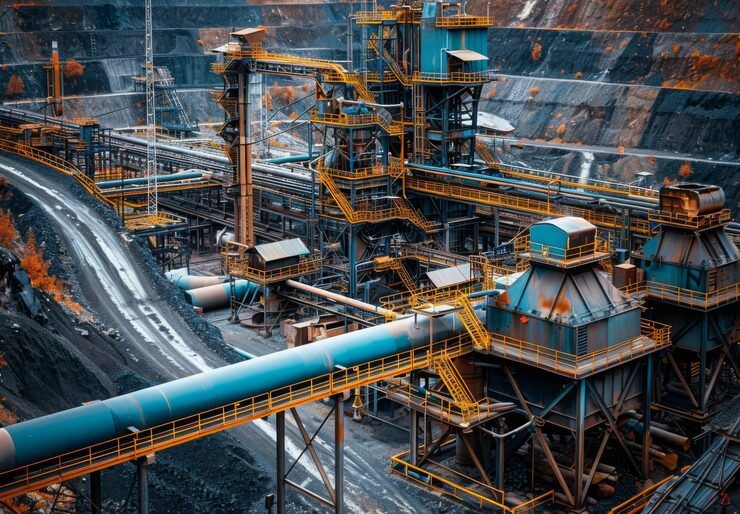
Mineral processing machinery is used to reduce, separate, classify, and concentrate minerals after they are extracted from natural deposits. Equipment such as crushers, screens, grinding mills, magnetic separators, flotation systems, and thickening units can perform different stages of mineral processing.
A modern mineral processing plant combines mechanical equipment, process controls, material-handling systems, and monitoring technologies. Understanding how these machines work helps students, plant operators, engineers, and general readers understand how mined materials are prepared for further processing and industrial use.
Context
Mineral processing refers to the treatment of mined material to separate valuable mineral components from unwanted material, commonly called gangue. The objective is to improve the physical or chemical characteristics of the material before subsequent processing or use.
Mineral processing machinery can be arranged into several stages. The exact sequence depends on the mineral, its properties, and the desired product characteristics.
Common equipment includes:
| Equipment | Main Function | Typical Processing Stage |
|---|---|---|
| Jaw Crusher | Reduces large rocks | Primary crushing |
| Cone Crusher | Further size reduction | Secondary or tertiary crushing |
| Vibrating Screen | Separates particles by size | Screening |
| Grinding Mill | Produces finer particles | Grinding |
| Magnetic Separator | Separates magnetic minerals | Concentration |
| Flotation Cell | Separates minerals using surface properties | Concentration |
| Thickener | Separates solids from liquid | Solid-liquid separation |
| Filter | Removes additional moisture | Dewatering |
The process normally begins with size reduction. Crushers break large pieces of ore into smaller particles. Screens classify these particles so that appropriately sized material can move to the next stage.
Grinding equipment then reduces particle size further when liberation of valuable minerals requires finer material. Separation methods are selected according to properties such as density, magnetic susceptibility, particle size, and surface chemistry.
Importance
Mineral processing machinery plays an important role because extracted ore usually contains a mixture of valuable minerals and other materials. Processing helps separate these components and prepare the material for later metallurgical or industrial processes.
The equipment selected for a processing circuit can influence factors such as:
- Particle-size distribution
- Mineral recovery
- Water consumption
- Energy requirements
- Material handling
- Process stability
- Waste generation
Different minerals require different processing approaches. Iron ore may involve crushing, screening, grinding, and magnetic separation. Copper ores can use combinations of crushing, grinding, flotation, thickening, and filtration. Industrial minerals may require classification, washing, drying, or other specialized processes.
Mineral processing also affects several groups, including mining engineers, plant operators, equipment technicians, environmental specialists, researchers, and regulatory authorities.
Recent Updates
Modern mineral processing is increasingly incorporating automation, sensors, advanced control systems, and data analysis. These technologies can help operators monitor equipment and process conditions continuously.
One important development is the increased use of online measurement. Sensors can monitor variables such as particle size, density, pressure, flow rate, temperature, and equipment vibration.
Digital control systems can use this information to adjust operating conditions. For example, automated systems can monitor a grinding circuit and adjust selected operating parameters according to changing feed characteristics.
Other developments include:
- Machine condition monitoring
- Automated sampling and analysis
- Advanced process control
- Digital plant models
- Remote equipment monitoring
- Improved energy management
- Water-recovery systems
- Sensor-based ore sorting
Ore sorting technologies can use characteristics such as X-ray response, optical properties, or electromagnetic behavior to distinguish different materials. Their application depends on the mineral deposit and the physical differences between target and non-target material.
Energy efficiency is another area of continuing research. Grinding can require substantial energy, so researchers and equipment manufacturers have investigated alternative grinding arrangements, improved classification, and more precise process control.
Water management is also receiving increased attention. Thickening, filtration, water recovery, and process-water recycling can help reduce freshwater requirements in appropriate plant designs.
Laws or Policies
Mineral processing facilities are subject to different environmental, workplace, water, waste, land-use, and mining regulations depending on their location and the nature of the operation.
In India, mineral-related activities operate within a regulatory framework that includes the Mines and Minerals (Development and Regulation) Act, 1957, along with environmental legislation and rules administered by relevant government authorities. Environmental clearances may be required for applicable projects under India's environmental assessment framework.
Air emissions, wastewater, solid waste, hazardous materials, and occupational safety can also be subject to specific requirements. The applicable rules depend on the type and scale of the facility.
Internationally, regulatory requirements vary considerably. Authorities may establish requirements for:
- Environmental impact assessment
- Water discharge
- Air-quality management
- Tailings and waste management
- Worker health and safety
- Land rehabilitation
- Chemical handling
- Monitoring and reporting
Operators need to identify the regulations applicable to their specific site rather than relying on general descriptions. Government agencies and official regulatory publications are appropriate sources for current requirements.
Tools and Resources
Several technical resources can help readers understand mineral processing machinery and processing circuits.
Useful resources include:
- Government mining and environmental authorities
- Geological surveys
- Engineering handbooks
- Mineral processing textbooks
- Equipment technical manuals
- Academic research databases
- Industry standards and technical publications
- Process simulation and calculation software
Process calculations are often used to estimate material balances, particle-size distributions, water flows, and equipment requirements. A basic material-balance calculation can help explain how much feed enters a circuit and how that material is distributed among different process streams.
Flow diagrams are also useful. A simplified circuit may follow this sequence:
Ore Feed → Crushing → Screening → Grinding → Separation → Thickening → Filtration
Actual plants can be considerably more complex. Circuits may include recirculation loops, multiple separation stages, stockpiles, blending systems, and different treatment routes for individual mineral streams.
When researching equipment, readers should examine technical specifications carefully. Important information can include throughput range, feed size, product size, power requirements, operating conditions, material compatibility, maintenance requirements, and control features.
FAQs
What is mineral processing machinery?
Mineral processing machinery refers to equipment used to reduce, classify, separate, concentrate, and dewater mineral materials. Examples include crushers, screens, mills, separators, flotation cells, thickeners, and filters.
What are the main stages of mineral processing?
Common stages include crushing, screening, grinding, concentration or separation, thickening, and dewatering. Not every mineral processing plant uses every stage.
Why is crushing important in mineral processing?
Crushing reduces large pieces of mined material into smaller particles. This makes subsequent screening, grinding, and separation processes more practical.
How does automation affect mineral processing equipment?
Automation allows sensors and control systems to monitor process conditions and adjust selected operating parameters. It can support consistent process control and equipment monitoring.
What factors influence equipment selection?
Important factors include mineral characteristics, feed size, required particle size, throughput, moisture content, separation properties, energy requirements, water availability, and applicable regulations.
Conclusion
Mineral processing machinery provides the physical systems needed to prepare and separate mineral materials through different processing stages. Crushers, screens, mills, separators, and dewatering equipment each perform specific functions within a processing circuit.
Recent developments are increasingly focused on automation, sensors, process control, energy management, water recovery, and improved monitoring. The appropriate equipment and process arrangement depend on the mineral characteristics, plant objectives, operating conditions, and applicable regulations.
Understanding the fundamentals of mineral processing machinery can help students, technical professionals, and general readers interpret processing diagrams and equipment specifications more effectively. Reliable technical manuals, government publications, engineering references, and academic research can provide additional information when evaluating specific processing technologies.