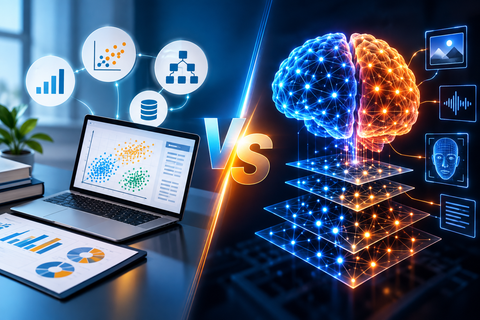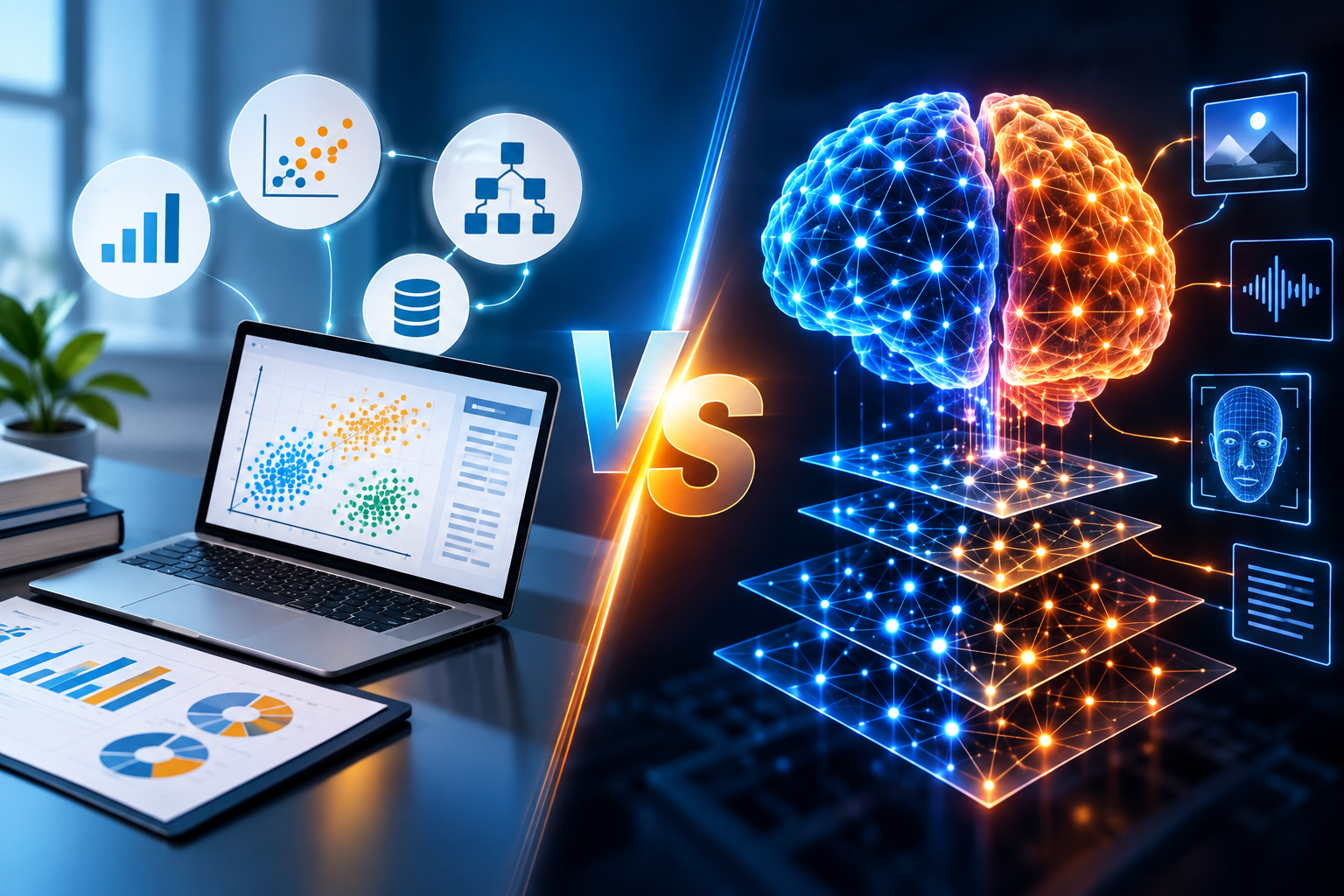
Machine learning and deep learning are closely related fields within artificial intelligence, but they differ in how they learn from data and how they are applied. Understanding the difference between machine learning vs deep learning can help readers identify the right approach for different technical and practical tasks.
Machine learning generally uses algorithms that learn patterns from structured or prepared data. Deep learning uses multi-layer neural networks and is particularly useful for complex data such as images, audio, video, and natural language. The following guide explains their differences, uses, recent developments, policies, and useful resources.
Context
Artificial intelligence (AI) is a broad field focused on developing systems that can perform tasks associated with human intelligence. Machine learning is a major branch of AI that allows systems to learn patterns from data rather than relying entirely on manually written rules.
Deep learning is a specialized area within machine learning. It uses neural networks with multiple computational layers to process information. These networks can learn increasingly complex representations from large datasets.
The basic relationship can be represented as:
| Technology | Main Approach | Common Data | Typical Uses |
|---|---|---|---|
| Artificial Intelligence | Broad field of intelligent computing | Many data types | Automation, reasoning, prediction |
| Machine Learning | Algorithms learn patterns | Structured and unstructured data | Prediction, classification, recommendations |
| Deep Learning | Multi-layer neural networks | Images, audio, text, video | Vision, speech, language processing |
Machine learning can use techniques such as regression, decision trees, support vector machines, clustering, and ensemble methods. Deep learning commonly uses architectures such as convolutional neural networks, recurrent neural networks, transformers, and other neural-network designs.
A key difference is feature handling. Traditional machine learning often depends on selecting or preparing useful features, while deep learning can learn representations directly from large amounts of raw or minimally processed data.
Importance
Understanding machine learning vs deep learning matters because the two approaches have different data, computing, development, and interpretability requirements.
Machine learning can be appropriate when datasets are relatively structured and the problem can be represented through meaningful features. It is used in areas such as fraud detection, demand forecasting, customer analysis, anomaly detection, and predictive maintenance.
Deep learning becomes particularly useful when the information is complex and high-dimensional. Examples include:
- Image and video analysis
- Speech recognition
- Natural language processing
- Document understanding
- Autonomous-system perception
- Generative AI applications
Deep learning models can require substantial computing resources and large datasets. Machine learning models can sometimes achieve useful results with less data and simpler infrastructure, depending on the problem.
The choice should therefore depend on the problem, available data, performance requirements, computing resources, development expertise, and the need for model interpretability.
Recent Updates
AI development has increasingly focused on large-scale models, multimodal systems, efficient computing, and responsible AI practices. Deep learning has played an important role in these developments because neural-network architectures can process multiple forms of information.
Transformer-based architectures have become important for language and multimodal applications. These models can process relationships between elements in sequences and can be adapted for tasks involving text, images, audio, and other data types.
Another development is the growing use of smaller and more efficient models. Techniques such as model compression, quantization, distillation, and specialized hardware can reduce the computational requirements of AI systems.
Machine learning workflows are also becoming more automated. Automated machine learning tools can assist with data preparation, model selection, evaluation, and deployment.
At the same time, organizations are paying greater attention to data quality, transparency, privacy, security, bias evaluation, and human oversight.
Laws or Policies
AI systems may be affected by different laws and regulatory frameworks depending on their location, application, and the type of data involved.
In the European Union, the EU AI Act establishes a risk-based framework for artificial intelligence. Different requirements can apply depending on how an AI system is classified and used.
In the United States, AI regulation involves a combination of federal guidance, sector-specific requirements, and state-level rules. Organizations may also need to consider existing privacy, consumer protection, employment, financial, and other applicable laws.
Data protection can be particularly important for machine learning and deep learning because models may be trained or evaluated using personal information. Organizations should determine whether data collection and processing comply with applicable privacy requirements.
Important areas to consider include:
- Data protection and privacy
- Transparency and documentation
- Security and risk management
- Human oversight
- Bias and discrimination risks
- Intellectual property considerations
Legal requirements can change as governments introduce new rules and guidance, so organizations should consult current official sources and qualified legal professionals when making compliance decisions.
Tools and Resources
A variety of tools can support learning, experimentation, and deployment of machine learning and deep learning systems.
Python is widely used for AI and data science. Common libraries include NumPy for numerical computing, pandas for data analysis, and scikit-learn for many traditional machine learning techniques.
Deep learning development commonly uses frameworks such as TensorFlow and PyTorch. These frameworks provide tools for building, training, evaluating, and deploying neural networks.
Other useful resources include:
- Jupyter for interactive programming and experimentation
- Hugging Face for machine learning models and datasets
- Kaggle for datasets, notebooks, and educational competitions
- Google Colab for browser-based computing environments
- TensorFlow documentation for deep learning concepts and tools
- PyTorch documentation for neural-network development
When evaluating a model, useful measurements may include accuracy, precision, recall, F1 score, mean absolute error, or mean squared error, depending on the task.
Choosing an Approach
A simple decision process can help:
- Define the problem and expected output.
- Identify the available data and its structure.
- Establish a suitable baseline model.
- Compare machine learning and deep learning approaches.
- Evaluate accuracy, computational requirements, and interpretability.
- Test the model on appropriate validation data.
- Monitor performance after deployment.
There is no universal method that works best for every problem. A simpler model can sometimes provide adequate results while being easier to understand and maintain.
FAQs
What is the main difference between machine learning and deep learning?
Machine learning is a broad category of methods that learn patterns from data. Deep learning is a subset of machine learning that uses multi-layer neural networks to learn complex representations.
Is deep learning a type of machine learning?
Yes. Deep learning is generally considered a specialized branch of machine learning. It relies primarily on neural networks containing multiple layers.
Which approach needs more data?
Deep learning often benefits from large datasets, especially for complex tasks such as image, speech, and language processing. Some machine learning methods can work effectively with smaller datasets when useful features are available.
Is machine learning easier to understand than deep learning?
In many cases, traditional machine learning models can be easier to interpret, particularly simpler models such as decision trees or linear regression. Some deep learning models can be more difficult to explain because of their complex internal structures.
Where are machine learning and deep learning used?
Both are used across many fields. Machine learning is commonly applied to forecasting, classification, anomaly detection, and predictive analysis. Deep learning is widely used for computer vision, speech processing, natural language processing, and generative AI.
Conclusion
Machine learning vs deep learning is not simply a comparison between two unrelated technologies. Deep learning is a specialized part of machine learning that uses multi-layer neural networks, while machine learning includes a broader range of statistical and computational techniques.
The appropriate approach depends on the data, problem requirements, available computing resources, performance objectives, and interpretability needs. Understanding these differences provides a useful foundation for exploring modern AI systems and their practical applications.
As AI continues to develop, both machine learning and deep learning are likely to remain important areas of research and application. Learning their basic concepts, limitations, evaluation methods, and responsible-use considerations can help readers better understand how modern intelligent systems are developed.